 Call or Shop In Store For Lower Prices (

Tiles
Large Format Tile Flooring: What It Is and Why It’s Trending in Ontario
Aug
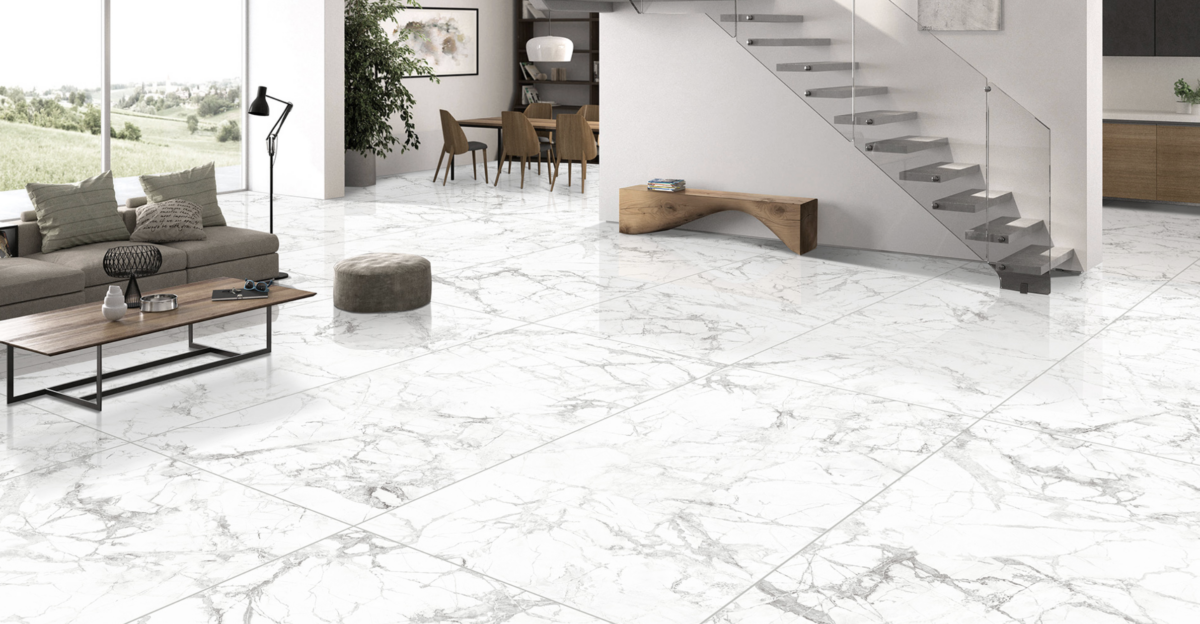
Walk into a newly renovated Ontario home or a modern showroom and you’ll likely notice the floors look sleeker and more seamless than they did a decade ago. That’s large format tile flooring at work. Across Ontario, homeowners and designers are reaching for bigger tiles to create clean, expansive, low-grout looks—and the trend shows no signs of slowing. Here’s what large format tile actually is, why it’s having a moment, and what to know before you install it.
Key Takeaways
- Large format tile generally means any tile with at least one edge 15 inches or longer, though many popular sizes are much bigger.
- Fewer grout lines create a cleaner, more continuous look and make floors easier to keep clean.
- Large tiles can make rooms feel bigger, which is part of why they’re trending in Ontario homes and condos.
- Installation is more demanding—subfloor flatness becomes critical, so professional installation is strongly recommended.
- Porcelain is the most popular material for large format flooring thanks to its strength and low water absorption.
What counts as large format tile?
There’s no single legal definition, but the Tile Council of North America generally classifies a tile as “large format” when it has at least one side measuring 15 inches or more. In practice, the category spans a wide range: common sizes include 12″×24″, 24″×24″, 24″×48″, and increasingly dramatic slab-style tiles that stretch several feet in each direction.
Large format tile flooring in Ontario is available in porcelain, ceramic, and natural stone, though porcelain dominates the category. Its density, strength, and low water absorption make it ideal for producing big, thin, stable tiles that hold up to real-world use.
Why large format tile is trending in Ontario
Several forces are pushing the trend forward at once.
A cleaner, more modern aesthetic. Fewer grout lines mean fewer visual interruptions. A floor laid with large tiles reads as one continuous surface, which suits the minimalist, open-concept style popular in Ontario new builds and condo renovations.
The illusion of more space. Smaller tiles chop a floor into a busy grid, while larger tiles stretch the eye across the room. In compact Toronto-area condos and cozy older homes alike, that space-expanding effect is a genuine selling point.
Easier maintenance. Grout is the hardest part of a tile floor to keep clean—it traps dirt and can stain over time. Fewer grout lines simply means less grout to scrub, which appeals to busy households.
Design versatility. Large format tiles now convincingly mimic marble, concrete, and wood, giving homeowners high-end looks without the upkeep those natural materials demand.
The benefits at a glance
| Benefit | Why it matters |
|---|---|
| Fewer grout lines | Cleaner look, less cleaning, fewer stain-prone joints |
| Space-expanding effect | Rooms feel larger and more open |
| Modern aesthetic | Suits open-concept and minimalist design |
| Durable materials | Porcelain resists wear, scratches, and moisture |
| Design flexibility | Realistic marble, stone, wood, and concrete looks |
What large format installation actually requires
Bigger tiles are more forgiving to look at but less forgiving to install—and this is the single most important thing to understand before you buy.
Subfloor flatness is critical. A small tile can bridge minor dips in a subfloor; a large tile cannot. If the surface isn’t flat within tight tolerances, large tiles can rock, crack, or “lippage” (where one tile edge sits higher than its neighbour). Proper preparation, including self-levelling compound where needed, is essential.
Specialized materials and technique. Large format tiles typically require a large-format-rated thin-set mortar and back-buttering (applying mortar to the tile as well as the floor) to ensure full support beneath the tile. Installers often use levelling clip systems to guarantee an even surface.
Handling and cutting. Big tiles are heavy and can crack if mishandled, and cutting them cleanly takes the right saw and experience.
For all these reasons, large format tile is one of the strongest arguments for professional installation. The cost of getting it right the first time is almost always lower than the cost of tearing out and redoing a floor that wasn’t laid on a properly prepared base.
Where large format tile works best
Large format tile shines in open living areas, kitchens, and spacious bathrooms where the continuous look can really breathe. It also works beautifully as a feature wall or in a walk-in shower, where the reduced grout is both attractive and more water-resistant. In very small or highly irregular rooms with lots of cuts, smaller tiles sometimes make more practical sense.
If you’re exploring options, browsing Flooring Liquidators’ tile collection is a good starting point, and their completed projects can help you visualize how large format tile looks at scale in real Ontario spaces.
Start shopping today
Large format tile flooring has earned its place in Ontario homes for good reasons: it looks modern, makes spaces feel larger, and cuts down on grout maintenance. The trade-off is that it demands a flat subfloor and skilled installation to perform as promised. Get those fundamentals right—ideally with professional help—and you’ll have a striking, durable floor that elevates the whole room. Visit a Flooring Liquidators showroom to see large format options in person, or shop online with Canada-wide shipping.
Frequently Asked Questions
What size is considered large format tile? Generally, any tile with at least one edge 15 inches or longer. Popular sizes include 12″×24″, 24″×24″, and larger slab-style tiles.
Is large format tile harder to install? Yes. It requires a very flat subfloor, specialized mortar, and careful technique, which is why professional installation is recommended.
Does large format tile really make a room look bigger? It can. Fewer grout lines create a more continuous surface that draws the eye across the room, giving an impression of more space.
What material is best for large format flooring? Porcelain is the most popular choice for its strength, stability, and low water absorption, though ceramic and natural stone are also available.
Can I put large format tile in a small bathroom? Yes, and the reduced grout can make a small bathroom feel larger—though rooms with many cuts and angles may require extra planning.